
 |
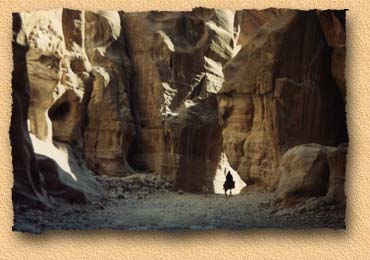
| The Siq before excavation. Photo by Paula Brown, all rights reserved |
The Siq, a natural gorge in Petra, extends for 1.216 kilometres and is the main passage the Nabataeans developed into Petra's formal entry way. It is hemmed in between cliffs up to 100 metres high and in places is no more than 2.19 metres wide. The sacred nature of the Siq as a processional way is attested to by the scores of carved niches, god blocks, and Greek and Nabataean inscriptions, all associated with Nabataean worship.
During the rainy season, water flows into the Siq from the surrounding wadis of al-Madrass, Jilf, Qantara and Khubtha through 19 faults and inlets. Water levels can rise to a height of 1.53 metres and flow at a velocity reaching five times the acceptable safety standard. To protect the citizens and their monuments from life-threatening and recurring flash floods, the Nabataeans designed and constructed an intricate network of hydraulic systems within the Siq and the areas flanking it. The most evident example of this network is the water channels carved into the sides of the Siq that carried water into the city. On the southern side, a grooved channel was carved into the rock, while on the northern side a ceramic pipe was built and enclosed. Both of these systems supplied water collected from a vast area within the Shara Mountains.
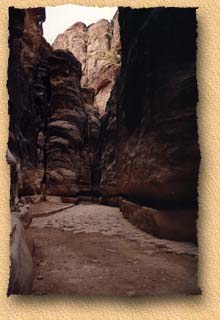 |
| The Siq after excavation and conservation work. PNT photo |
Over the centuries, Petra suffered a gradual decline. Severe devastation is believed to have occurred between 363 and 636 a.d., when three powerful earthquakes struck the region. The pavement of the Siq and the hydraulic systems were severely damaged and the upper half of the Siq floor (600 metres) gradually eroded, washing rubble and pavement slabs to the lower 600 meters.
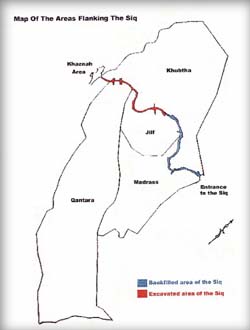 |
| Map of the Siq. PNT illustration |
In pursuance of its mandate, PNT assessed the cumulative damage and decided to restore, as much as possible, the Siq to its original glory. With funds obtained through the governments of Jordan and Switzerland, and in coordination with the Jordanian Department of Antiquities, a Jordanian engineering firm, and a Swiss archaeologist, the excavating and restoring of the Siq began.
Initially, ten soundings were conducted to establish the original level of the pavement. They revealed that in places the original pavement was 3.85 metres below the existing floor, whereas in the upper half of the Siq, in places it was up to 2.5 metres above the present floor level.
Approximately 11,000 cubic meters of rubble were removed from the Siq's lower 600 metres, part of which was then used to backfill the upper 600 metres. This restored the floor to its original grade of approximately 5 percent, which was a vast improvement from the steep, inconsistent slope of 13 percent prior to excavation. This excavation also reduced the velocity of water flow during flashfloods, and rendered the Siq more comfortable for visitors.
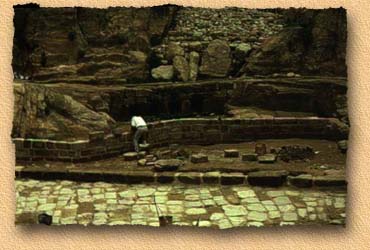 |
| Conservation work being done in the Siq. PNT photo |
The pavement uncovered during the excavation revealed signs of heavy use in ancient times as there is evidence of deep wheel tracks from carriages and chariots in the lower half of the Siq. Sidewalks for pedestrians were also discovered in several areas.
In addition to uncovering the water channels and filtration cisterns, a number of sanctuaries were found and restored, and numerous niches containing Nabataean, Greek and Latin inscriptions were uncovered. The most exceptional find was the sculpture of a camel caravan, carved out of bedrock on the southern side of the street. The carving clearly shows two pairs of camels with their guides leading them: the upper pair is headed down toward the Khazneh, whereas the lower pair is headed toward the Siq entrance. The carving of the guide is 1.3 times the size of an average person, and is remarkably well preserved, showing the lower portion of the man's clothes, sandals and staff.
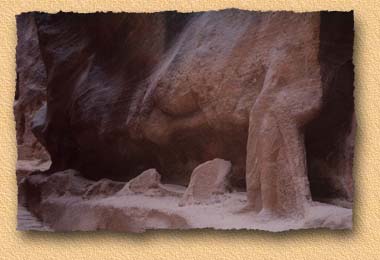 |
| The Camel Caravan relief showing the lower portion of the guides body and the feet and bodies of the camels. PNT photo |
In 1999, the portions of the Siq floor that remain without pavement stones will be covered with a layer of consolidation material, composed of aggregates, silica, and acrylic and latex modifiers. This consolidant will protect the surface from further erosion, and at the same time will protect the indigenous vegetation in the Siq from dust caused by pedestrians and horses. The area to be covered by the consolidant is approximately 7,000 square metres, or 55 percent of the entire surface.
By completing this project, the PNT will have provided a safer, more comfortable and considerably more fascinating passage into Petra. PNT now hopes to continue excavation in the Khazneh Plaza area to reveal its original level and archaeological treasures.